Risen Indeed
Most years we attend an Easter Homeschool Family Retreat which brings together lots of families who are friendly to the idea of singing chant, but need printed materials to support participation.
At first I made Regina Caeli cards with the Latin words only, but soon people requested the English be printed in three too. Turns out there are many different variations on the English translation, especially swimming around in my own head. Compare these two collects:
| sandhurst.catholic.org.au | catholic.org |
|---|---|
| O God, who hast given joy to the whole world | O God, who by the Resurrection of Thy Son |
| through the Resurrection of They Son, | our Lord Jesus Christ; |
| our Lord Jesus Christ; | didst deign to give joy to the world: |
| grant that through the prayers | grant we beseech Thee, |
| of His Virgin Mother Mary, | that through His Mother, the Virgin Mary, |
| we may obtain the joys of everlasting life. | we may obtain the joys of everlasting life. |
| Through the same Christ, our Lord. | Through the same Christ, our Lord. |
Sometimes the word “prayers” is replaced by “intercession” and some use “vouchsafe” instead of “deign.” These little differences make it tricky if the aim is to have a bunch of people speaking the words aloud together.
One answer is that the collect be said by just one person, which seems to be the way collects usually happen in the Divine Office. Another very attractive one is to have everyone recite the Latin, though this doesn’t seem to really catch on.
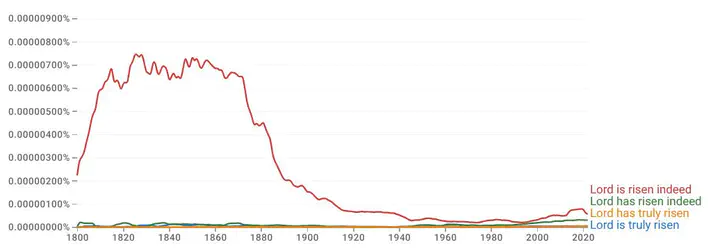
Anyway, the collect isn’t the real point here. The Versicle and Response has been bugging me, as we often say this in English. When I first put the English on the cards, I translated the response as “For the Lord is truly risen” without much thought. After a few retreats, this started to bug me as most of my brain wanted to say “For the Lord is risen indeed”. So I thought I’d try surveying people and amongst the retreatants it came out equal between the two options. On my Youtube channel, “risen indeed” came out ahead by a fairly small margin.
That’s where Google Books Ngram Viewer came out ahead with this graph
“The Lord is truly risen” is beaten by each other variation, giving a huge victory to “The Lord is risen indeed”, particularly in books published between 1800 and 1920.
I don’t really know of any etymological or theological reason to favour one over the other. Truly seems a more literal translation of vere, but I think the rhythm is the deciding factor. The use of is instead of has is interesting. Has implies something more in the past whereas is describes something ongoing and present.
Final Note: have a read through the Paschal Greetings from around the world. Though this is an Orthodox website, I have known Catholics from Greece and Poland keeping this same custom.

Veronica Brandt
Technician and Tutor
My research interests include Gregorian chant, knitting, constructing long skirts with pockets and taking over the world.